 Jordan Lin, Dr Rosie Riley
Victims and survivors of human trafficking and exploitation suffer significant harm to their physical and mental health as a result of their trauma, forced high-risk work, poor living and working conditions, exploitation and abuse. However, despite the need, individuals may be prevented from accessing healthcare or fear presenting themselves due to threats, force, lack of trust of professionals and the help that may be available, fear they won’t be believed, fear of identification and immigration repercussions, or lack of awareness of where and how to access healthcare. Sadly there can be significant system barriers to accessing healthcare including individuals being turned away from registering in primary care without proof of address or ID, poor access to adequate interpreting services, data poverty and therefore inability to call 111/999, access online GP systems or receive emails, or long waiting lists. Despite this victims and survivors do present in healthcare settings. This is often due to illness, injury or circumstances that prevent them from working and therefore earning money for their traffickers e.g. infections, fractures or pregnancy. If they do present it is often with more serious or delayed presentations with complications.
Because of the reasons above, victims of trafficking are unlikely to feel safe to disclose their exploitation with professionals during their first encounters. It is common to not self-identify as a victim of exploitation at all or to feel shame, guilt and humiliation, all barriers to asking for the help they need. Therefore healthcare professionals should use trauma-informed care and communication skills with all patients, particularly when there is suspicion of underlying abuse of any kind.
Trauma-informed communication and consultation skills involve recognising the harmful impact of traumatic experiences and the necessary survival adaptations that might result from this trauma while treating people with compassion and respect. This approach can help reduce distress and risk of re-traumatisation, as well as help build trust with survivors in a professional setting. It is through these trauma-informed encounters that anyone begins to feel safe, build trust and down-regulate important survival responses, which drive the fight, flight, freeze or appease behavioural adaptations that are there to prevent further harm.
Human trafficking and exploitation can have a large impact on a person’s physical and mental health. If you suspect that a patient may be a victim then there are a number of signs that you can look out for. Some of these are outlined in the TRAFFICKED pneumonic below. This list is not exhaustive.
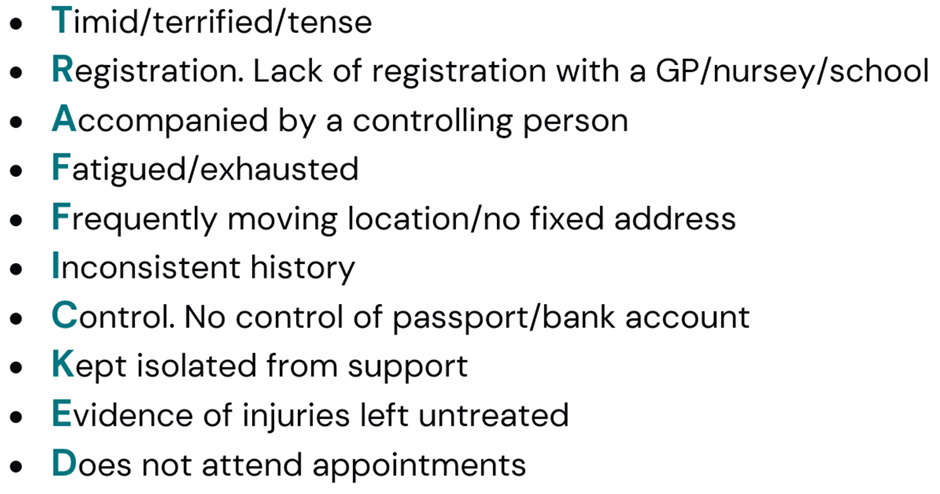
Alongside significant physical and sexual harm and poor background health due to lack of access to primary care, survivors experience immense psychological distress from their exploitation, increasing the risk of developing mental health problems, such as Post-Traumatic Stress Disorder (PTSD), Complex PTSD, psychosis, anxiety and depression.
However to survivors or the traffickers, attending healthcare services may be perceived as a significant threat and risk of identification, therefore mental health consequences may be intentionally not obvious, with symptoms minimised to reduce suspicion and unwanted questioning. The aim of the interaction in a healthcare setting being to receive treatment for the presenting complaint as swiftly as possible and to leave to go back to work. It is important for healthcare professionals to be aware of this and to navigate the consultation sensitively, providing that space and perhaps time for trust-building, all the while being aware of how their patient is responding.
As with anyone experiencing trauma and even PTSD, patients may completely avoid speaking about traumatic aspects of their history or be reluctant to answer specific questions in order to avoid triggering symptoms such as flashbacks, panic attacks and psychological distress. In any situation that is a perceived or real threat, an individual’s behaviour may suggest underlying trauma and adaptive survivor responses. e.g. fight – aggression to scare or hurt someone before they hurt you, flight – needing to run away (“absconding”) to prevent harm, freeze – not engaging to reduce harm coming to you, appease – doing whatever anyone says, if you resist that’s when you get hurt. Some survivors may appear withdrawn, detached or disinterested. At its most extreme these signs could be indicative of dissociation. Dissociation is a trauma response resulting in temporary, often recurring detachment of a person’s mind from their emotional state and body. More information about dissociation can be found in our previous blog here (A Closer Look at Dissociation – VITA Network).
In all cases, professionals should communicate sensitively and observe for any signs of dissociation or distress. Although not always possible it is important to make sure your consulting environment is appropriate and confidential and to ensure comfort as much as possible. As a professional relationship of trust is established using trauma-informed care, the aim of the consultation shifts to planting seeds that suggests to the patient – you’re an individual worthy of dignity and care, and when you’re ready this is a safe place and we are safe people. It is in that place of safety and trust that the professional will become better placed to understand the needs of the individual in front of them.
Presentations of victims and survivors can vary greatly and any individual will be in different stages of being able to share their experiences. No matter the extent of disclosure, any healthcare professional encounter with someone who has experienced human trafficking is an opportunity to help them progress towards a situation of safety, stability and wellbeing through a trauma-informed approach and the building of trust.
References and further reading:
If you’re a healthcare professional, VITA training aims to equip you with the transferable practical communication and consultation skills to create that safe, confidential, trauma-informed space in a clinical context. We learn in more detail phrases to use, how to remove an accompanying person from the room in a way that’s routine, natural and fluent so as not to raise their alarm, how to build rapport using interpreters. Learn from real health professionals who know what it’s like to have these encounters and apply these skills in their consultations in a busy GP clinic or emergency department in the middle of the night. If you’re interested in attending have a look at our website and book onto a course – www.vita-training.com.
The Trauma-Informed Code of Conduct, For all professionals working with survivors of Human Trafficking and Slavery. Trauma Informed Code of Conduct (TICC) | Helen Bamber.